Google Stopped Showing Review Stars for Clinics
What It Actually Means for Your Website

If the stars have disappeared from your clinic’s Google search result, it is understandable to wonder whether something is wrong with your website.
The calm answer: not necessarily. Industry reporting suggests Google has reduced the visibility of review snippets for healthcare pages, even where the review structured data is valid. But there has been no official Google announcement confirming a permanent change for the whole healthcare sector.
Your reviews still matter. And changing your website markup in a rush to bring back a search result feature could create more problems than it solves.
What changed with Google’s review stars?
On 7 October 2026, Search Engine Roundtable reported that review rich results, the stars that can appear alongside some organic search listings, were no longer showing for healthcare pages in the searches being observed.
The report followed observations from Schema App. Its healthcare customers had seen review snippet visibility decline from late May, with a further decline for some organisations in early August. Tests of different ways to connect review ratings and healthcare entities did not restore the visibility.
That is useful industry reporting, but it is not a statement from Google. It also does not mean every clinic result has changed in exactly the same way. Search results can vary, and Google decides whether to show a rich result even when a page’s markup is valid.
So, if your stars have gone, resist the urge to assume your website has broken.
What has not changed?
A missing star beside an organic search result does not mean your patient reviews have disappeared or stopped helping people choose a clinic.
Reviews can still be seen on your Google Business Profile, where patients often check recent feedback, location details and opening hours. Reviews also help prospective patients feel more confident when comparing local services.
That is different from saying reviews guarantee better rankings. Google’s results are influenced by many factors. But patient feedback remains an important part of the trust and decision-making picture, whether or not a star appears in a standard website listing.
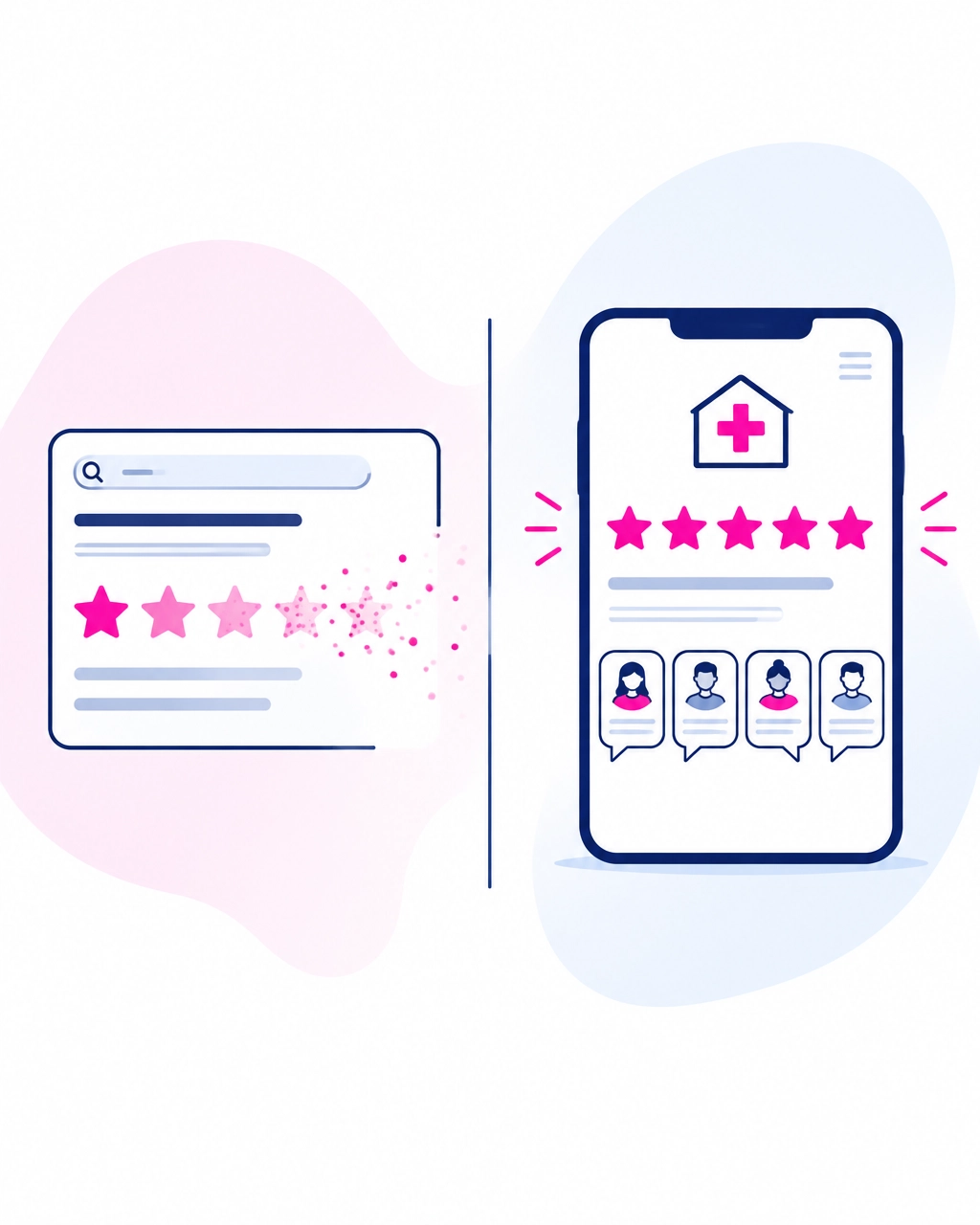
If you are thinking about reviews as part of your wider patient journey, you may also find our article on the 4.0-star cliff and patient reviews helpful.
Don’t change your schema just to chase the stars
This is the part many clinic owners may find counterintuitive:
the best response may be to leave accurate structured data alone.
Structured data, sometimes called schema markup, is information in your website’s code that helps search engines interpret what a page is about. It can describe real-world details such as your clinic, practitioners, services and locations, and how they relate to one another.
That information has a job beyond earning stars. It helps search engines, and other systems that interpret web content, understand your clinic more accurately.
When a search feature disappears, it is tempting to rewrite the markup until it returns. But changing accurate information to chase a particular display can mean telling search engines something that is confusing or untrue.
For example, avoid:
- Adding a rating that is not clearly shown on the page.
- Attaching reviews to the wrong clinic, practitioner or service.
- Using markup to imply an endorsement or relationship that does not exist.
- Adding extra entity types simply because someone suggests they might trigger stars.
- Copying reviews or ratings from another source without making their origin and context clear.
In particular, do not assume that adding an
AggregateRating
rating to a clinic page will make the stars return. Google has specific rules about which review markup may be eligible, and displaying markup does not guarantee a rich result. Read Google’s
structured data policies and
Local Business structured data guidance before making changes.
The useful test is simple: does the markup accurately describe what a visitor can see on the page and how your clinic actually operates? If yes, do not distort it to pursue a search decoration.
If you are unsure whether your website’s data is accurate, that is a sensible reason to review it, not a reason to panic-edit it.
Four calm steps to take now
1. Keep asking for genuine feedback
Continue inviting patients to share honest feedback in a way that feels natural and low-pressure. Make it easy to find your review page, but do not tell people what to write or what rating to leave.

2. Respond thoughtfully
A calm, professional reply shows that your clinic listens. Thank patients for positive feedback. If someone raises a concern, acknowledge it and invite them to continue the conversation privately. Avoid sharing personal or clinical details in a public response.
3. Keep your Business Profile up to date
Check that your clinic name, address, phone number, opening hours and services are current. Keep an eye on new reviews and respond when appropriate. This supports a clear, consistent experience for people discovering you locally.
4. Check Search Console without overreacting
Google Search Console can help you see whether review-related search appearances, impressions or clicks have changed. Compare periods and look at the broader picture too: are your pages still receiving organic visits? Are patients still contacting or booking with you?
A change in one search feature is worth noticing. It is not, by itself, proof that your entire SEO performance has fallen.

Rich results are only one part of visibility
Stars can make a result stand out, and it is reasonable to value them. But they are one presentation feature, not the whole purpose of your website or your structured data.
Your site still needs to make it easy for people and search engines to understand what care you provide, who provides it, where your clinic is and how to take the next step. Clear service pages, accurate practitioner information, useful local details and a straightforward booking journey all matter.
That is why good local SEO for clinics is not simply a hunt for one special result. It is the steady work of building an accurate, helpful online presence that supports patients as they search and decide.
At HealthClinicWebsites.com, we create, manage and market websites for health clinics. As a healthcare digital marketing agency, we understand the needs of practices and can help with website design, local visibility and practical tools such as online booking. You can also explore what we offer.
Keep your focus on being understood
The reported change is worth keeping an eye on, but it is not a reason to fake, stretch or break your schema. Your reviews still have a role in building trust, and accurate website information still matters, even if a search result does not show a star.
If you would like a second pair of eyes on your clinic website or local SEO, contact us for a free consultation. We can help you understand what is working, what may need attention and what can safely wait. No drastic changes needed.
Recent Posts